In April 2025, FirstRand Bank issued its inaugural women-owned-business social bond, raising R2.53 billion through three-, five- and seven-year notes. The proceeds are intended to finance or refinance loans to women-owned micro, small and medium-sized enterprises (MSMEs) through FNB. The issuance comes amid persistent barriers to accessing business finance in South Africa. Surveys confirm the scale of the challenge. FinScope’s 2024 South Africa MSME survey found that half of the business owners surveyed identified sourcing money as a challenge when starting their businesses. This burden was particularly pronounced among women in Mastercard’s 2025 survey, with 57% of female entrepreneurs reporting difficulty securing funding, compared with 45% of men.
FirstRand’s first allocation and impact report covers the position at 30 June 2025, approximately three months after issuance. Although the bond has now been outstanding for more than a year, this remains the latest publicly available bond-specific data. The report therefore cannot support a final assessment of impact, but it shows how much of the proceeds had been allocated at that early stage, the eligible loans to which they were allocated and what remains to be demonstrated.
This early assessment applies Steward Research’s four-stage framework for evaluating gender bonds.1 The framework offers an analytical lens rather than a formal market standard. As one of the early gender-focused bonds issued in Africa, FirstRand's issuance offers an instructive early test case for how these instruments are being structured and reported on across emerging markets.
1. A clear need, but reach is unclear
The bond is intended to support women who own or lead businesses in South Africa, responding to a well-established need. What is less established is whether the framework FirstRand uses to act on that need is matched by reporting that shows who, within that broad population, is actually being reached. To identify which loans can be financed or refinanced with bond proceeds, FirstRand's sustainable finance framework defines a women-owned business as one that is at least 51% owned by women. A business with at least 20% ownership by women can also qualify if a woman holds a senior executive role and women occupy at least 30% of board seats, where a board exists.
These criteria give a clear definition of an eligible business, but that definition covers a broad population. It does not give priority to particular groups based on business size, location or other characteristics. Broad eligibility is not necessarily a weakness. Women-owned businesses in different circumstances may all have legitimate financing needs, and narrower criteria could unnecessarily exclude some of them. It does, however, make detailed reporting on who is actually reached more important, since eligibility alone cannot show this.
The focus on business finance is appropriate: limited funding can restrict a firm's ability to invest, meet working-capital needs or expand. But women-owned businesses do not all face the same obstacles. Some may lack conventional collateral or an established credit history. Others may find that available loans are too costly or poorly suited to their needs. FirstRand's framework identifies the target population but does not specify which of these barriers the bond is intended to address.
Future reports could close this gap by disaggregating the number and value of loans by enterprise size, sector and location, including the share directed to microenterprises, rural businesses and black women-owned businesses. This would show how the bond's funding is distributed, and whether it is reaching the businesses most likely to face severe barriers to finance, allowing a more meaningful assessment of the bond's targeting.
2. New finance or a new source of funding?
Beyond identifying which women-owned businesses the bond reaches, assessing its potential impact requires examining additionality: whether the bond expands or improves financing beyond what FNB would have provided anyway.
FirstRand can allocate bond proceeds to two categories: refinancing eligible loans FNB provided in the 12 months before issuance, and financing new loans originated afterward. FirstRand has until 1 April 2027 to allocate the full R2.53 billion, and aims, on a best-efforts basis, to direct at least half of proceeds to post-issuance loans and no more than half to refinancing.
As at 30 June 2025, approximately three months after issuance, FirstRand had allocated R1.615 billion, or 64% of the bond, across 2,881 women-owned businesses: 2,102 through refinancing and 779 through new lending. The allocation breakdown at that date is shown below:
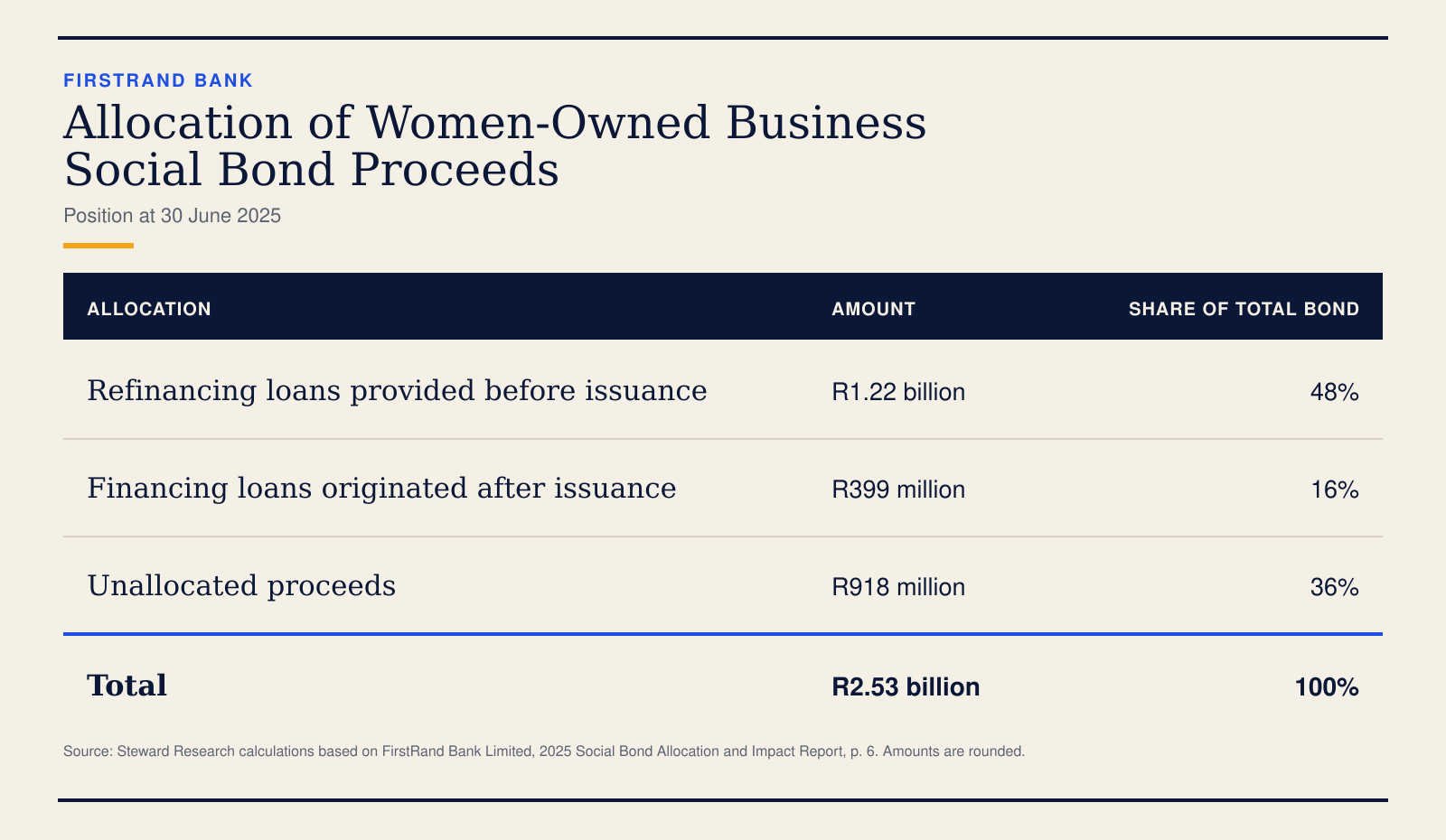
Although the bond's terms require that the proceeds be allocated by 2027, they do not require a particular mix between refinancing and new lending. As a result, full and on-schedule allocation would confirm that the funds were deployed, but would not, on its own, confirm that the bond expanded access to finance beyond what FNB's ordinary lending would have provided. That distinction, between allocating capital and expanding access to it, is the central question this report and future reporting will need to address.
The refinanced loans, however, had already been made before the bond existed. Their inclusion does not by itself demonstrate additionality. Refinancing could still contribute to additionality if it freed up capacity FNB then used for further lending, but the report does not show whether this happened.
The R1.215 billion refinanced through the bond represents roughly 2% of FNB's existing women-owned-business loan book. In absolute terms, this is a small share of FNB's overall lending. It is, however, the portion of the bond where additional disclosure would be most valuable, since these are loans that existed before the bond and were brought into its portfolio afterward. Future reporting could show whether this refinancing enabled FNB to make new loans it would not otherwise have made, which would allow the 48% to be assessed on the same basis as the post-issuance portion. The central question is not whether FNB can identify eligible loans, but what the bond adds to lending it would have done regardless.
A separate dimension of additionality concerns price, not just volume: whether bond-funded loans are offered on more favourable terms than FNB's standard lending. FirstRand's framework refers to affordable credit but does not disclose pricing, fees, collateral requirements or maturities for bond-funded loans. Individual loan terms may reasonably stay confidential, but aggregated disclosure, such as average pricing spreads, typical loan terms, or the share of borrowers receiving preferential rates, compared with FNB's standard SME lending, would let readers assess additionality on price without requiring commercially sensitive detail.
Taken together, future reporting could benefit from disclosing whether refinancing freed up any lending capacity and, if so, how it was used. It could also disclose how bond-funded pricing, fees and loan terms compare with FNB's standard SME lending, even in aggregated form. This would allow readers to assess whether the bond's finance is genuinely additional and offered on suitable terms for the women it is intended to serve.
3. Is finance accompanied by enabling support?
FirstRand’s wider strategy for supporting SMEs, including women-owned businesses, refers to market access, business networks, technical assistance, financial literacy and business-skills training. Such support is important because some of the constraints facing women-owned businesses are not financial and cannot be addressed through access to capital alone.
However, the available documents do not establish whether the 2,881 businesses financed or refinanced through the bond received, or were connected to, any of these services. Enabling support may be available through FNB or its wider network of partners, but its connection to this particular financing remains unclear.
Future reporting could indicate whether businesses financed through the bond were offered or referred to non-financial support, the types of support available and, where tracked, the number that participated. It could also clarify whether this support was provided by FNB or through external partners and whether it formed part of the bond programme or FNB’s wider SME initiatives.
4. Are meaningful outcomes assessed?
FirstRand has established credible controls over the use of proceeds. Eligible assets are screened and tracked, while KPMG provided limited assurance over the management of allocated and unallocated funds. These controls support the integrity of the allocation process, but they do not establish the bond’s social impact.
The first report states that 2,881 women-owned businesses were financed or refinanced. This is an important measure of the bond’s reach, but it is an output rather than evidence of what changed for those businesses. The report does not indicate whether borrowers gained first-time access to credit, received more affordable or otherwise improved financing terms, increased employment or experienced business growth.
FirstRand’s sustainable finance framework identifies possible indicators including increased access to affordable financial services, women-owned enterprises funded and jobs created for women. Of these, the first report provides only the number of enterprises funded. Given that the report covers the early stages of the bond, it may be too soon to observe longer-term business outcomes. However, neither the framework nor the report sets out which outcomes will be assessed over time, the baseline or targets against which progress will be measured, or the data that will be used.
This could be addressed by distinguishing between new and refinanced borrowers and reporting, where feasible, changes in financing terms, employment or selected measures of business performance. Disclosing the assessment period, data sources and methodology would also help. Indicators of possible financial stress, such as arrears or restructuring, would further establish whether the financing is supporting borrowers or placing them under excessive repayment burdens. At present, the report can confirm what proceeds were spent on, but not yet whether that spending is changing outcomes for the women-owned businesses it is intended to support.
What should come next?
FirstRand made rapid early progress in allocating the bond proceeds, established controls over their use and obtained independent limited assurance over the allocation information. Its best-efforts commitment to direct at least half of the proceeds to post-issuance lending is also a meaningful feature of the bond.
The short reporting period means that longer-term effects on employment or business growth would not yet be expected. As the bond matures, however, reporting should move beyond allocation by showing which businesses are reached, including first-time borrowers; whether post-issuance lending and refinancing expand or improve access to finance, including through more favourable pricing or terms; whether borrowers are connected to non-financial support; and how changes in business performance and possible financial stress will be assessed.
Three months of data is too early for a final verdict on impact. At present, the report confirms that proceeds have been allocated to eligible loans associated with women-owned businesses. It does not yet demonstrate whether the bond has expanded access to suitable finance or improved outcomes for the businesses it is intended to support.