Goal 5 of the UN Sustainable Development Goals aims to achieve gender equality and empower all women and girls, an ambition that requires significant investment in expanding women's economic opportunities. The need for such investment is particularly pressing in emerging and developing economies, where formal women-owned micro, small and medium-sized enterprises face an estimated financing gap of approximately $1.9 trillion. 1
Gender bonds have emerged as one way of mobilising capital to help close this gap. These instruments allow companies, banks and governments to raise money for initiatives that advance gender equality and women's economic empowerment. Like conventional bonds, investors provide funding in return for regular interest payments and eventual repayment of their investment. What makes a gender bond different is that the issuer commits to directing the money towards clearly defined gender-related objectives and reporting on how it has been used. In practice, this may mean financing women-owned businesses, improving women’s access to essential services or supporting their participation in employment and leadership.
Gender bonds remain a very small part of the sustainable-bond market. Using the IFC’s broader “Women’s Economy Bonds” category, an estimated $36 billion was issued in 2025, equivalent to roughly 3% of global sustainable-bond issuance that year.2 Although their market share remains small, issuance is increasing, particularly in emerging markets. According to the IFC, annual emerging-market issuance grew eighteenfold between 2020 and 2025, with cumulative issuance in these markets reaching $57 billion between 2016 and 2025 across more than 40 countries.3
This growth presents an important opportunity to expand women's access to finance at scale. Its impact, however, will depend on how effectively the capital raised is directed and used. In emerging and developing economies, this requires gender bonds to be designed around the circumstances of the women they are intended to support. These circumstances vary considerably both across and within countries, industries and income groups, as do the capacity of local financial institutions, the availability of reliable data and the barriers women face in accessing and using finance. If gender bonds are to contribute meaningfully to women’s economic empowerment in these markets, these differences must inform how eligible activities are selected, finance is delivered and results are measured.
What, then, should issuers consider when preparing to issue a gender bond in an emerging or developing economy? A proposed four-stage Gender Bond Impact Alignment Framework sets out the key considerations. It follows the pathway from identifying a local need to structuring suitable finance, delivering it responsibly and defining how outcomes will be assessed. Rather than guaranteeing impact, the framework identifies the conditions that can make meaningful outcomes for women more likely.
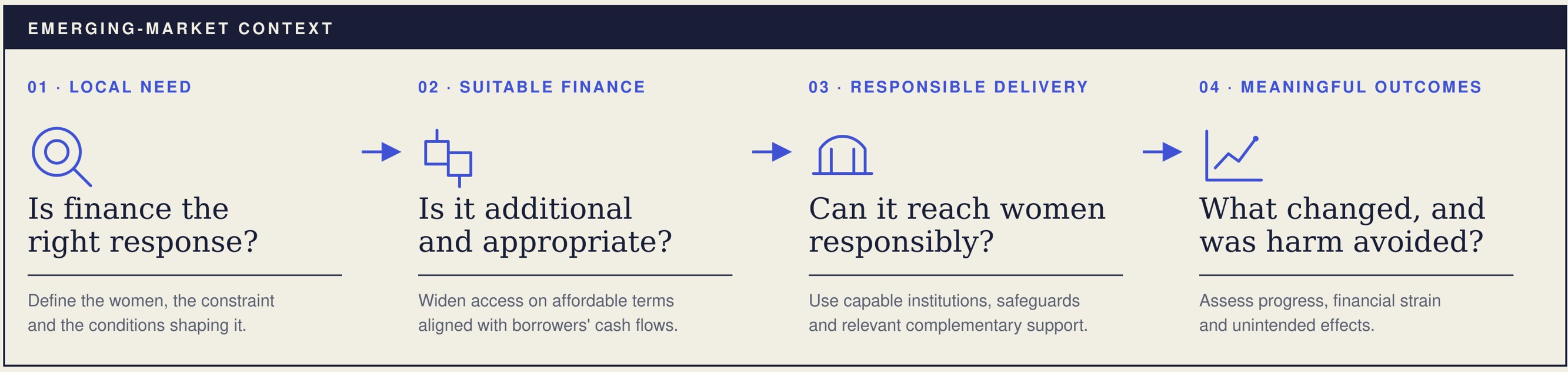
1. Begin with a clearly defined local need
Before issuing a gender bond, an issuer should clearly identify the problem the financing is intended to address. "Supporting women" is not a sufficiently precise objective because women do not form a single economic group with identical financing needs. A woman running a small agricultural business may need seasonal working capital, while the owner of an established manufacturing company may need longer-term finance for equipment and expansion. These differences shape both the type of finance required and how it should be structured.
In emerging and developing economies, women's circumstances are often shaped by factors like informality, geography, sector, income and social norms. Some may lack credit, collateral or formal business records. For others, finance may not be the primary constraint: limited market access, unreliable infrastructure or restrictions on owning assets may be more significant.
Identifying the underlying constraint matters because it determines whether finance is an appropriate response, what form it should take, and what else may be needed alongside it. The bond’s eligible activities should be grounded in evidence about the intended beneficiaries and the local conditions affecting their economic participation.
The question for issuers is: Which women is the bond intended to support, what is preventing them from participating more fully in the economy, and is finance an appropriate response?
2. Provide additional finance on suitable terms
Once the need has been established, the issuer should determine whether the proposed finance offers something that the intended borrowers cannot already obtain. A gender bond that primarily finances women who already have adequate access to conventional credit may increase lending volumes without meaningfully expanding financial inclusion.
A well-designed bond should seek both to widen access for underserved women and to improve the terms on which they can obtain and use finance. This might include affordable pricing, repayment periods aligned with business cash flows, or collateral requirements that do not depend solely on formal property ownership. The objective is not necessarily to provide more debt, but to address a financing constraint in a way that leaves borrowers better placed to use and repay the loan.
This is particularly important in emerging markets, where high interest rates, inflation, currency volatility and irregular incomes can affect repayment capacity. A short-term loan requiring immediate monthly repayments, for example, may be poorly suited to an agricultural business that earns most of its income after harvest. Loan size, cost, currency, maturity, collateral requirements and repayment schedules should therefore correspond with the intended use of the finance and the borrower’s cash flow.
The question for issuers is: Does the bond provide finance that is genuinely additional, appropriately structured and affordable for the women it is intended to serve?
3. Combine finance with the support required to use it effectively
Access to finance may not be sufficient if women face other constraints that prevent them from using capital productively. Depending on the market and target group, borrowers may also need business-development support, financial-management skills, assistance with formal registration, access to suppliers and customers, digital capabilities or guidance on complying with procurement requirements.
This does not mean that every gender bond must finance a large training programme. The appropriate support should follow from the initial needs assessment. An established manufacturing business seeking growth capital will require different assistance from a first-time borrower operating an informal retail enterprise.
The delivery institution is critical here. Banks and other intermediaries will usually identify borrowers, assess applications, distribute funds and monitor repayment. They must therefore have the local reach, expertise, incentives and systems required to serve the intended women. In markets where conventional underwriting depends on formal accounts, titled property or established credit histories, institutions may need appropriate alternative methods of assessing viable but underserved businesses.
Responsible delivery also requires transparent pricing, suitable underwriting, complaints mechanisms and safeguards against over-indebtedness. Expanding women’s access to credit should not expose them to financial products they do not understand or cannot reasonably repay.
The question for issuers is: Can the institutions involved deliver the finance responsibly and provide, or facilitate access to the complementary support borrowers need to use it effectively?
4. Define meaningful outcomes and how they will be assessed
Before the bond is issued, the issuer should define what success would look like and how progress will be assessed. Reporting the amount lent and the number of women reached is important, but these figures describe the distribution of finance rather than its effects. The appropriate outcomes will depend on the problem identified at the beginning. For a bond financing women-owned enterprises, relevant indicators might include changes in revenue, profitability, employment, business survival or access to more affordable finance. If the objective is greater economic empowerment, indicators could also examine women’s control over business income or participation in financial decision-making.
The assessment plan should include baseline information where feasible, a realistic timeframe and clearly identified sources of data. It should also monitor possible adverse outcomes, such as arrears, repeated refinancing, high debt-service burdens or borrower financial stress.
Data collection should reflect local conditions. Many informal and very small businesses lack audited accounts or consistent financial records, while financial institutions may have limited systems for collecting gender-disaggregated data. Requiring borrowers to produce extensive documentation could therefore exclude some of the women the bond is intended to support. Financial institutions should instead collect proportionate information that allows them to assess changes in borrowers’ circumstances and provide investors with credible evidence of the bond’s progress.
The question for issuers is: What changes should the finance achieve, and how will the issuer reliably assess both progress and potential harm?
As the gender-bond market grows, its success should not be measured solely by the volume of capital raised or the number of beneficiaries reached. In emerging and developing economies, where women’s financing needs, institutional capacity and local conditions differ widely, meaningful impact depends on alignment between the constraint identified, the finance provided, the institutions delivering it and the outcomes assessed. The most effective gender bond will not necessarily be the one that mobilises the largest sum, but the one that tackles a meaningful barrier to women’s economic participation, avoids imposing undue financial strain and demonstrates tangible improvements in women’s economic circumstances.
References
- International Finance Corporation and SME Finance Forum, "MSME Finance Gap: An Updated Estimation and Evolution of the MSME Finance Gap in Emerging Markets and Developing Economies" (Washington, DC: IFC, March 2025), https://www.smefinanceforum.org/data-sites/msme-finance-gap. ↩
- Author's calculation based on the IFC's provisional estimate of $36 billion in Women's Economy Bond issuance and S&P Global Ratings' estimate of approximately $1 trillion in global sustainable-bond issuance in 2025. See S&P Global Ratings, "Global Sustainable Bond Issuance to Hold Steady at $1 Trillion in 2025" (February 5, 2025), https://www.spglobal.com/ratings/en/regulatory/article/250205-sustainability-insights-global-sustainable-bond-issuance-to-hold-steady-at-1-trillion-in-2025-s13402934 ↩
- International Finance Corporation, Women’s Economy Bonds Update #2: Financing Women’s Entrepreneurship, Leadership & Jobs (April 2026), https://www.ifc.org/content/dam/ifc/doc/2026/bond-market-assessment-for-women-s-economic-empowerment-update-2.pdf ↩